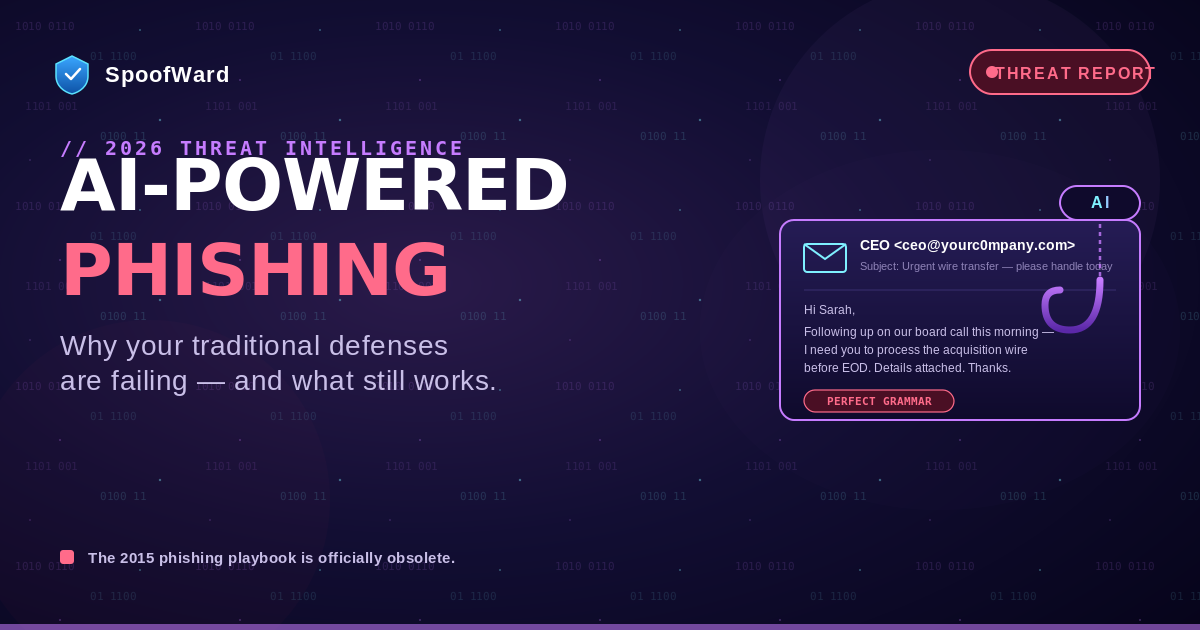
For twenty years, the advice for spotting phishing emails was the same. Look for bad grammar. Watch for weird formatting. Hover over links and check the URL. Be suspicious of anyone asking for urgent action. Trust your instincts if something feels off.
That advice is now dangerously outdated.
Generative AI has quietly transformed phishing from a numbers game played by teenagers with copy-paste templates into a precision-guided attack platform capable of writing perfect English, mimicking your CFO's writing style, cloning your customers' logos in seconds, and running an interactive back-and-forth conversation with a target — all at zero marginal cost. The security assumptions that protected your business for two decades no longer hold.
This is not a distant threat. It is already happening, at scale, right now. And most companies are still running the same 2015 playbook against a 2026 adversary.
What Actually Changed
Understanding the shift matters because the wrong mental model leads to the wrong defenses. Here is what generative AI has broken.
Bad grammar was your best filter — and it's gone. For years, the reason most phishing emails were obvious was that they were written by non-native speakers using template kits. Grammar mistakes, awkward phrasing, and unusual word choices were the tell. Large language models write flawless business English in any language, in the tone of any industry, at any level of formality. That signal is now noise.
Personalization used to be too expensive to fake. A targeted phishing email that referenced your recent LinkedIn post, mentioned your VP's name correctly, and knew your company's internal jargon used to require an actual human researcher spending hours on reconnaissance. Now an AI agent can scrape a target's LinkedIn, company blog, GitHub, press releases, and podcast appearances in seconds and generate a tailored message. Mass phishing is now personal phishing at mass-phishing prices.
Voice and video cloning are commodity tools. In 2024, criminals used a deepfake video call impersonating a CFO to steal $25 million from a single company in Hong Kong. That was a headline event because it was novel. By 2026 it is routine. Modern voice cloning needs three seconds of source audio from a public podcast interview. Video cloning needs a LinkedIn photo. The vishing calls impersonating your CEO now sound exactly like your CEO.
Logo and brand cloning takes seconds. AI image models can reproduce any brand's visual identity — logo, colors, fonts, email template layout — from a single reference. Combined with a lookalike domain, the resulting phishing email is visually indistinguishable from a real one. Even attentive users cannot spot the fake by looking at it.
Interactive attacks now happen in real time. The most sophisticated 2026 phishing does not just send an email and wait. It initiates a conversation. If the target replies asking to verify identity, an AI agent responds naturally, adjusts its story, and continues to build trust across multiple exchanges. Some campaigns hand off to a human closer only after the AI has warmed the target up. Your employees are now negotiating with something that never gets tired, never breaks character, and has read every publicly available conversation you have ever had.
Why Old Defenses Are Failing
The defenses most companies still rely on were built for the pre-AI era. Every one of them has degraded.
User awareness training assumes red flags. The core message of every phishing training program — spot the misspellings, notice the weird URL, trust your gut — is now training people to look for signals that no longer appear. Modern AI phishing has no misspellings, uses convincing lookalike domains, and passes every gut check. Users who "pass" the training feel confident and then get compromised anyway.
Spam filters miss too much. Content-based filtering that flagged suspicious phrasing, poor formatting, or known scam patterns cannot flag prose that is grammatically perfect and rhetorically appropriate. Volume-based filtering fails because AI enables low-volume, high-precision campaigns that never trip rate limits.
Sender reputation is bypassed by hijacked accounts. The single most successful modern attack vector is not spoofing at all — it is compromising a legitimate account (yours, your vendor's, your customer's) via credential theft, then sending the phishing message from a real, reputable inbox. Reputation-based defenses see a trusted sender and pass the message through.
"Don't click suspicious links" collapses under URL cloaking. Legitimate marketing tools rewrite URLs for tracking. Legitimate SaaS platforms host content on subdomains that look nothing like their brand. Users have been trained to accept unfamiliar link patterns because their own vendors keep sending them. The "hover and check the URL" heuristic is dead.
What Actually Still Works
The defenses that hold up in the AI era have a specific character: they do not depend on the recipient noticing anything. They shift verification from the human to the infrastructure.
Cryptographic identity via DMARC, SPF, and DKIM. AI cannot forge cryptography. A message that fails DMARC alignment is rejected regardless of how convincingly it is written. A domain at p=reject cannot be spoofed by any AI, no matter how sophisticated. This is why the fundamentals of email authentication have quietly become the single most important defense against AI phishing — they work at the protocol layer, not the content layer, and the content layer is exactly where AI wins.
Visual verification via BIMI. When your customers have learned to associate your logo with your emails, the absence of that logo becomes a phishing signal. An AI-generated phishing email cannot produce a valid BIMI logo because it does not control your DMARC alignment or your Mark Certificate. Over time, customers' eyes learn to filter for the logo without any conscious effort — which is a defense that scales even as attacks get more sophisticated.
Multi-factor authentication that resists phishing. SMS and TOTP-based MFA still get phished by real-time proxy attacks. But hardware security keys (WebAuthn/FIDO2) are effectively immune, because the key cryptographically verifies the domain it is authenticating to. Even a user who falls for the world's most convincing phishing page cannot hand over their credentials to an attacker if their security key refuses to unlock on the wrong domain.
Out-of-band verification for high-value actions. Any request involving money movement, credential changes, wire transfers, or vendor changes should require verification through a channel other than the one the request came in on. If the CEO emails asking for a wire transfer, someone calls the CEO on their known phone number. If the CFO Slacks about updating payment details, someone confirms in person or through a separately-authenticated channel. This is inconvenient. It is also the only defense that survives voice cloning.
Zero-trust architecture at the identity layer. Assume every account might be compromised. Require re-authentication for sensitive actions. Monitor for anomalous behavior even from known accounts. This does not stop phishing from reaching users, but it dramatically limits the damage when phishing succeeds.
The Strategic Shift Every Business Needs to Make
The old model of email security was perimeter-based: keep the bad stuff out at the gateway. The AI era demands a new model: assume the bad stuff will get through, and make it structurally impossible for it to do harm.
That is a fundamental shift in mindset. It means investing less in filters that try to identify "suspicious" messages (a losing battle) and more in cryptographic identity, phishing-resistant authentication, and process controls that prevent any single message from triggering a catastrophic action.
It also means acknowledging that user training, while still worth doing, cannot be the primary defense. Any strategy that boils down to "hope your employees notice something feels off" is a strategy for losing to AI. The employees who fall for AI phishing in 2026 are not the careless ones. They are the alert, thoughtful, well-trained ones who did everything right by 2015 standards.
What to Do This Quarter
Practical priorities for the next 90 days.
Move DMARC to enforcement. If your DMARC policy is still at p=none, this is the single highest-leverage action you can take against AI phishing. Every phishing email impersonating your domain that gets rejected at the protocol layer is one that never reaches a human to fool.
Roll out hardware security keys or platform passkeys. For every account that matters — email admin, cloud infrastructure, finance systems, HR — replace SMS and TOTP with WebAuthn. The economics are dramatically better than most security investments and the attack surface reduction is enormous.
Rewrite your "verify before you act" policies. Any workflow that can be triggered by an email — vendor payment changes, wire transfers, credential resets, invoice approvals — needs a documented out-of-band verification step. Practice it. Make it culturally normal, not friction to work around.
Update your phishing training. Stop teaching people to spot bad grammar and start teaching them the shift: that phishing in 2026 will look perfect, sound perfect, and reference correct details. The only reliable defense at the individual level is process — "when in doubt, verify through another channel" — not pattern recognition.
Audit your BIMI and DMARC posture. BIMI is now high-leverage precisely because AI phishing cannot fake it. If your DMARC is at enforcement, deploy BIMI. If it is not, get it there.
The Uncomfortable Truth
The economics of phishing have changed permanently. What used to require a human hour of work now requires an AI second. What used to require a native English speaker with reconnaissance skills now requires a $20-per-month subscription. Every attacker on earth has access to tools that would have looked like science fiction three years ago.
Companies that respond by doing more of what worked in 2015 will lose. The ones that respond by shifting to infrastructure-level defenses — cryptographic identity, phishing-resistant authentication, process controls that survive perfect impersonation — will be fine. The gap between those two groups is going to widen fast in 2026.
Choose which group you belong to. The AI is not going to slow down and wait for you to catch up.
Stay in the loop
Get notified when we publish new email security insights.